Shimaqua - journal editorial collective
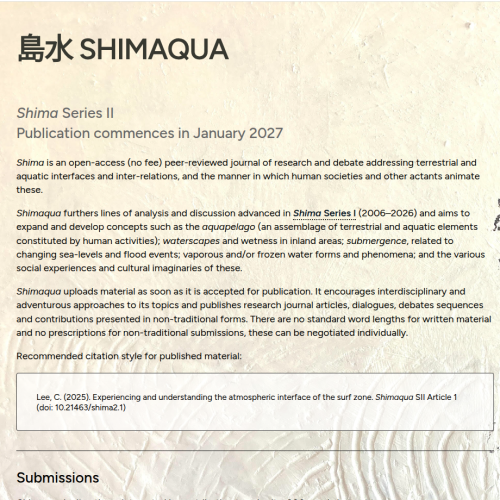
Tuesday, 5 May 2026I’m excited to be a part of the new editorial collective behind a new iteration of the journal Shima. Shima Series II Shimaqua furthers lines of analysis and discussion advanced in Shima Series I (2006–2026) and aims to expand and develop concepts such as the aquapelago (an assemblage of terrestrial and aquatic elements constituted by human activities); waterscapes and wetness in inland areas; submergence, related to changing sea-levels and flood events; vaporous and/or frozen water forms and phenomena; and the various social experiences and cultural imaginaries of these.
A special thanks to Philip Hayward for inviting me to join this new editorial collective. As the editor of Shima, Philip has developed it into a space for creative scholarship on marine environments and island imaginaries. Shima was the first journal to feature Crystal and I’s collaborative artwork on land reclamation here in Macao and has been a regular source of inspiration for my ongoing research on algae, atmospheres, Chinese folklore, deep sea mining, and land reclamation in the South China Sea. It is my pleasure to be working alongside, Ruhi Deol (Independent, Koblenz, Germany), Tashima Thomas (Southern Methodist University, Dallas, Texas), Francesco Visentin (University of Udine, Italy), Mari Yamasaki (University of Mainz, Germany) and Lisa Zecchin (University of Padova, Italy) on this new project.
Thank you for helping to spread the word about Shimaqua as it is now open for submissions and inquiries with the first issue online in early 2027: https://shimajournal.net Shimaqua is an open-access (no fee) peer-reviewed journal of research and debate addressing terrestrial and aquatic interfaces and inter-relations, and the manner in which human societies and other actants animate these.
Shimaqua uploads material as soon as it is accepted for publication and encourages interdisciplinary and adventurous approaches to its topics. The journal publishes research journal articles, dialogues, debates sequences and contributions presented in non-traditional forms. There are no standard word lengths for written material and no prescriptions for non-traditional submissions, these can be negotiated individually.